
Back
How Pump.fun Works: Launch a Memecoin, What It All Costs, and Where to Trade
A complete guide to how Pump.fun works: token creation, bonding curves, graduation, fees, creator earnings, and how to trade Pump.fun tokens with a professional edge.

Silo
April 10, 2026
Synopsis
Pump.fun turned Solana memecoin creation into a one-click process and became the first Solana-native protocol to surpass $1 billion in cumulative revenue. This guide covers every layer of how the platform actually works, from launching a token to trading one, and explains how Trojan Terminal gives traders the tools to compete seriously in that environment.
Intro
Pump.fun launched in January, 2024, and within two years it became the most revenue-generating protocol ever built natively on Solana.
The core concept is simple: anyone can create a Solana token in seconds, trading starts immediately on a bonding curve, and the platform collects a percentage fee on every trade.
Whether you want to launch a token, trade one, or just understand the mechanics of the operation, this guide covers it all.
A Very Brief History of Origins: Why Pump.fun Was Built
Pump.fun was created by three early-20s UK developers, Noah Tweedale, Alon Cohen, and Dylan Kerler, who had a specific problem in mind: memecoin launches on Solana were broken. The prevailing model required developers to seed their own liquidity, set up pools manually, and ask buyers to trust them not to drain that liquidity as soon as the price moved. Drainers, honeypots and rug pulls were too common.
The founders built a system where that trust was no longer required:
Liquidity - held by the protocol.
Pricing - automated and deterministic.
Token creation - no technical knowledge required.
Removing the hidden contract function risks from the pre-graduation phase lowered the psychological barrier to participation. Add that to a fast, cheap blockchain like Solana, and volume was inevitable.
Pump.fun is, in essence, a volume machine.
How to Easily Create a Token on Pump.fun

Creating a token on Pump.fun requires no code, no presale, no technical background. And the whole process takes less than a minute.
The process looks like this:
Navigate to pump.fun
Connect a Solana wallet (Phantom is the most common)
Fill out a simple form: token name, ticker symbol, optional description, and an image.
Your image is the most important creative decision you will make, since Pump.fun tokens are meme-native assets where visual identity drives early attention.
Creator fee distribution is configurable before launch.
Once you deploy, the platform mints a new SPL token with a fixed total supply of one billion tokens.
A bonding curve goes live immediately. No presale, no team allocation, no vesting schedule, no manual liquidity pool setup. Token creation is free.
As of March 25, 2026, there is a hard rule: you get one post-launch opportunity to redirect the fee recipient address. After that single change, the configuration locks permanently on-chain.
The Bonding Curve: What You Don’t Know About Pricing

All trading on a newly launched Pump.fun token happens on the platform's proprietary bonding curve.
It’s not a traditional order book. It’s not a standard liquidity pool. It’s a constant-product automated market maker using virtual reserves to set price, with all SOL held in the curve contract.
The starting parameters are two-fold, virtual and actual:
Virtual token reserves begin at approximately 1.073 billion tokens and virtual SOL reserves begin at 30 SOL.
Actual token reserves available for sale are approximately 793 million tokens and actual SOL reserves start at zero.
As buyers send SOL into the curve, virtual and real SOL reserves increase, and token reserves decrease, pushing the price up along the curve. When sellers return tokens, the process reverses.
Practically, this means early buyers get significantly cheaper entries than later buyers.
The major milestone is “Graduation”, which occurs when all approximately 793 million real tokens have been sold through the curve. This requires roughly 85 to 86 SOL accumulated in the curve contract. The exact USD value figure fluctuates with SOL price. Once this threshold is reached, the token automatically migrates to PumpSwap.
Graduation and PumpSwap: What Happens When a Token Breaks Out

Graduation is automatic and requires no action from the creator or any trader. When the bonding curve fills, the platform deducts a fixed fee of 0.015 SOL to cover network costs, then uses the remaining SOL (approximately 85 SOL) plus the unsold token supply (~207 million tokens) to create a canonical liquidity pool on PumpSwap.
PumpSwap is Pump.fun's native decentralized exchange (DEX), which launched in March 2025 and displaced Raydium as the destination for graduated tokens. LP tokens from the pool creation are burned immediately, meaning liquidity cannot be withdrawn by the creator. Once a token is on PumpSwap, it trades as a standard AMM with continuous open-market price discovery.
Tokens that do graduate and build momentum occasionally do reach significant market caps. Fartcoin hit a $2.4 billion peak market cap in January 2025. Peanut the Squirrel ($PNUT) reached $400 million. These are few and far between, but they exist, and they fuel continued participation.
The Fee Structure: Some Hard Money Numbers
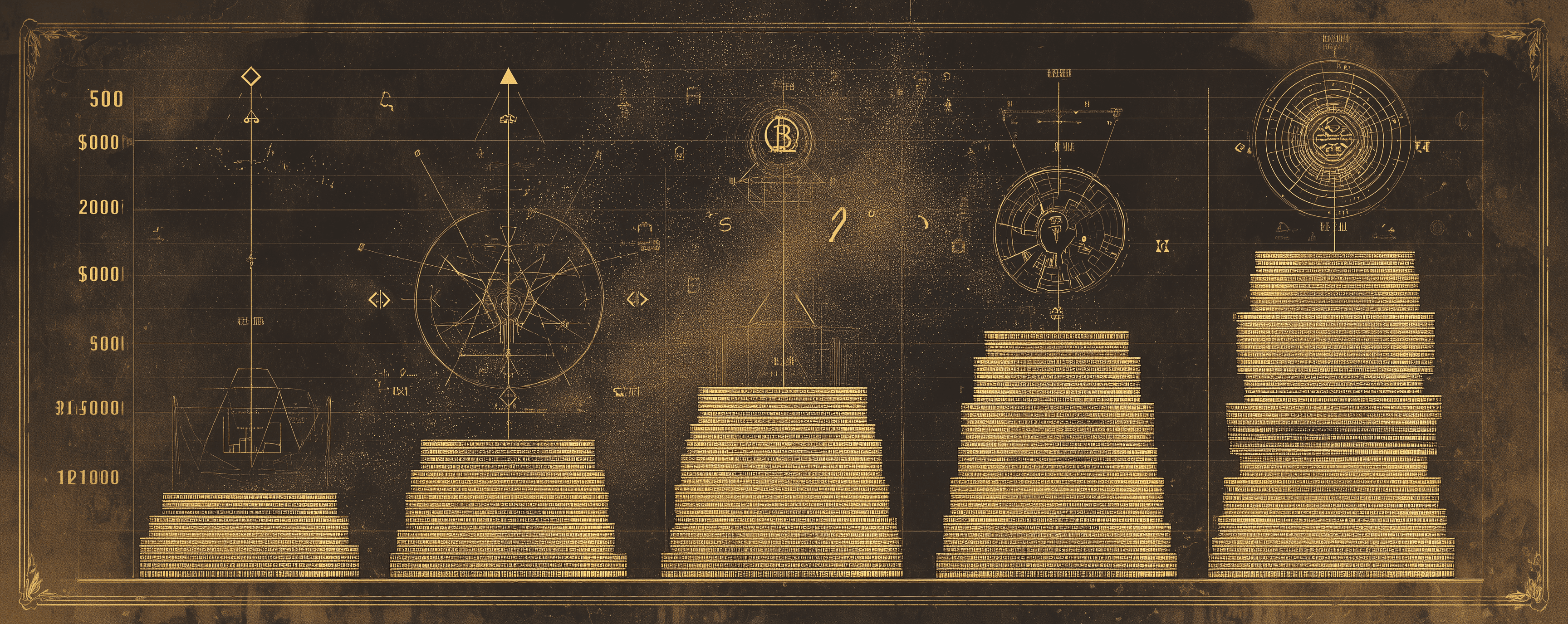
Pump.fun's revenue model is fee-based. All fees are enforced on-chain by smart contracts.
Before graduation (bonding curve)
Every trade on the bonding curve carries a total fee of 1.25%, split as follows:
Creator: 0.300%
Protocol (Pump.fun): 0.950%
LP: 0%
After graduation (PumpSwap canonical pools)
Creator fees start high on smaller graduated tokens and taper as market cap grows. Protocol fees drop sharply above a certain cap. LP fees remain at 0.200% throughout.
0 to 420 SOL market cap: the total fee is 1.25%, with the creator earning 0.300%, the protocol earning 0.930%, and LP earning 0.020%.
420 to 1,470 SOL: the creator share jumps to 0.950% while the protocol fee drops to 0.050%, reflecting the platform's design choice to reward early momentum heavily.
1,470+ SOL: the creator share decreases in steps from 0.950% down to 0.050% at the highest tier (98,240 SOL and above), where total fees settle at 0.300%.
Non-canonical pools on PumpSwap, meaning pools that were not created through standard graduation, carry a flat 0.300% total fee, with 0% to creators, 0.050% to the protocol, and 0.250% to LPs.
Earnings Behemoth
Pump.fun generated approximately $321 million in protocol fees in 2024, $664 million in 2025, and approximately $98 million in the first quarter of 2026. Daily revenue regularly runs between $700,000 and $1 million in the current environment, with peaks that exceeded $15 million per day during the January 2025 bull market.
Total cumulative protocol revenue crossed $1 billion in March 2026, making it the first Solana-native protocol to reach that milestone.
Creator Fees in Practice: Who Gets The Money

The creator fee is the portion of trading volume that flows to the wallet designated by the token's deployer. There are three basic models:
Basic Creator: Since January 2026, that designation can be split across up to ten wallets with custom percentage breakdowns, all enforced on-chain. Recipients claim accumulated SOL at any time through the Pump.fun interface, and fees never expire.
CTO: For tokens where the original developer has gone inactive, a formal Community Takeover (CTO) process allows a new admin to inherit the creator fee stream. The community must submit documented evidence of abandonment for Pump.fun's review. If approved, the new Coin Admin gains full rights including fee sharing and ownership transfer.
Direct to Traders: Cashback coins are a third model where, when deploying, a creator can permanently redirect 100% of the creator fee slice back to traders as an automatic rebate on every trade. This decision is locked at launch and cannot be changed. Cashback coins cannot undergo CTO.
Trading Pump.fun tokens is almost an entire other world from that of launching. There are individuals who, over their history have launched tens of thousands of tokens and have made millions off of them. These individuals are often labelled “serial ruggers”.
Attempting to trade launches effectively requires an entire other toolkit from launching. It means competing against infrastructure built specifically to front-run manual participants.
Trading Pump.fun Tokens: Without the Right Tools You’re Doomed

While connecting a wallet and launching tokens directly on Pump.fun is straightforward, the actions for trading are severely limited. The native interface lacks advanced order types, real-time contract analysis, and has zero tooling to evaluate a token before committing capital. It is built for only the most casual participation.
Trojan Terminal is strategically built for trading the launchpad environment. It provides real-time Pump.fun token feeds with zero-delay bonding curve tracking, Token Audits, limit orders, DCA order functionality with a chart-based range selector, and MEV protection against front-running and sandwich attacks.
Copy trading lets you mirror wallets with verified performance histories, accessible directly through the Wallet Analyzer. Broad-based filter options help weed out “vamp attacks” and other launches that would otherwise seem enticing.
Without a terminal like Trojan, most buyers will only find poverty.
The Hard Reality: What the Data Shows

Approximately 98.6% of tokens launched on Pump.fun exhibit pump-and-dump or rug-pull characteristics, per a Solidus Labs analysis. Of more than seven million tokens tracked, fewer than 97,000 ever sustained more than $1,000 in liquidity after launch.
Dune Analytics data from March 2026 shows that of 1.4 million wallets trading Pump.fun tokens that month, roughly 96% either lost money or profited less than $500. Gains concentrate in early participants, bots, and skilled traders who move faster than the market.
The bonding curve is technically fair. In practice, automated bots operating within milliseconds of launch capture a structural advantage.
Whether you're launching a new coin, reviving a dormant project, or riding the next moonshot, success on Pump.fun comes down to timing, the right idea, and the tools to execute before everyone else does.
With Bitcoin roots stretching back to 2016 and “full‑time” status since 2021, Silo blends data‑driven writing with cryptonative expertise. As Trojan’s communications lead, he covers everything from trading tools to referral rewards, meme coins to market caps. In his spare time he writes sci-fi and lore.
More Posts

© 2025 Trojan Trading. All rights reserved.
Systems Operational