
Back
Trojan Features: Limit and DCA Orders
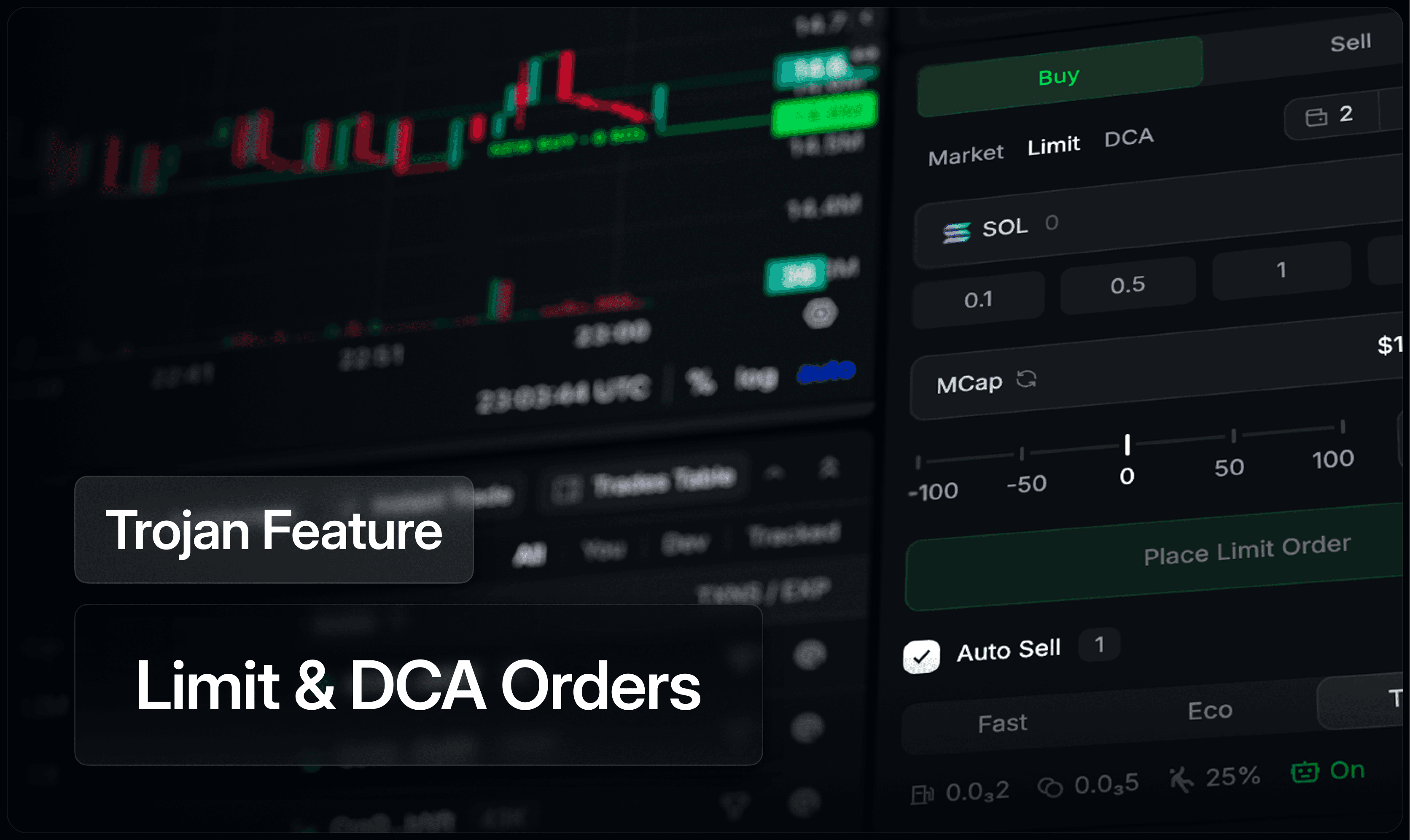
Trojan’s terminal supports advanced Limit and DCA Orders on Solana, letting traders automate entries, manage risk with Stop-Loss and Take-Profit logic, and execute structured accumulation or distribution strategies without manual execution.

Silo
December 29, 2025
Synopsis
Trojan’s Limit and DCA Orders bring precision and automation to Solana trading. Set price or time-based triggers to buy, sell, or accumulate automatically, reducing emotion, minimizing slippage, and maintaining consistent execution across volatile markets.
What is a Limit Order?
The term Limit Order actually covers a very broad range of types of orders, but at the core, it just means any order triggered by an “event”. The event can be passage of time, price reaching a predetermined level, or even another wallet buying or selling. The central theme is one of preplanning rather than reaction.
Here we cover the two most basic Limit Orders on Trojan:
Price-based triggers (known simply as Limit Orders)
Time-based triggers (known as Dollar-Cost Averaging or DCA)
We assume you read, or already understand the content of, our Market Orders post. If not, it is worth giving it a skim before proceeding.
Price-Based Limit Orders
Basic Limit Orders are very simple to grasp. A trader believes the price of a token will move lower before increasing again. Therefore, they put in an order to buy at that lower price. If the price goes there, the swap takes place. If not, it doesn’t. And vice versa for sells.
Here’s an example: GAMBOL coin is trading at $2. You think the structure suggests it is overbought, so you put in a limit buy order for 1000 coins at $1. Price then drops to 90¢, your order gets filled on the way down, you own 1000 GAMBOL. You then put in a limit sell order for $1.50. Price rises back to $2 and on the way up your sell triggers and you now have $1500.
A trader who had market bought at $2 would not have seen a gain, and would have in fact had to stomach a >50% draw down in the process. Whereas a limit order allowed the trader to capture a gain, only endure a small drawdown, and to give attention to other matters while waiting for the market to come to their price.
The potential downside to utilizing a price-based Limit Order rather than a Market Order is that price may never reach your expectations (i.e. missed entries or missed exits).
The Stop-Loss
A subset of these price-based Limit Orders is the Stop-Loss. The Stop-Loss is just a limit sell order that is triggered if the price drops to a predefined level. A Stop-Loss helps to “limit” the amount of “loss” a trade can possibly incur (ignoring the possibilities of slippage and liquidity rugging). With Trojan, users can simultaneously post Take-Profit and Stop-Loss orders creating a pre-set risk profile. With Autosell enabled, this is even simpler.
Using the above example: Let’s say you bought the same amount of GAMBOL at the same $1 price point and you were only willing to actually risk $200. Putting a Stop-Loss at 80¢ means, should the token price decrease that far, your position would be offloaded and you would only lose the $200. Risk limitation.
Time-Based DCA Orders
DCA (or Dollar-Cost Average) Orders are limit orders designed around the idea of accumulation or distribution over time. The general idea is that, at fixed time intervals, for a user-determined period of time, the trader will buy or sell a fixed amount.
Continuing with our example: Let’s say you want to spend $1000 on GAMBOL tokens. You set up a DCA of 10 buys total, 1 buy every minute. This means each buy will be $100 (no matter what the price is), and the total time to run the DCA will be 9 minutes (the first buy happens immediately).
NOTE: Because DCA is a time-based and not a price-based limit order, the price at which purchases are made will vary.
Why Use DCA Orders?
DCA serves a couple of unique purposes for the active trader:
Flattens the effect of volatility on average purchase price
Avoids causing sudden rapid spikes or dips in price from large purchases
Decreases likelihood of MEV attacks or slippage eating purchases or profits
While DCA can, and is used in a variety of situations, it is particularly useful (on the buy side) for tokens you expect to have significant upside and are planning to buy heavily into, or (on the sell side) tokens you hold a significant position in and want to offload without destroying the chart or in small increments on the way up.
DCA is not a particularly useful tool for microcaps or fresh launches unless the buy/sell interval is extremely short. The volatility and lifespan generally do not align well with DCA strategies.
The Wrap-Up
Limit Orders are an exceptionally useful tool for active traders. So far we have only covered the common price-based Limit Order, the Stop-Loss, and DCA Orders, but there are several more sub-types of limit orders, which we will cover in a later article.
Trojan provides all these and much more in a user-friendly interface built to give traders of all skillsets and experience levels the edge they need to keep calm and win big in the market.
With Bitcoin roots stretching back to 2016 and “full‑time” status since 2021, Silo blends data‑driven writing with cryptonative expertise. As Trojan’s communications lead, he covers everything from trading tools to referral rewards, meme coins to market caps. In his spare time he writes sci-fi and lore.
More Posts
© 2025 Trojan Trading. All rights reserved.
Systems Operational