
Back
Trojan vs Photon 2026: Unlimited Autosell & Real Rewards vs No Cashback
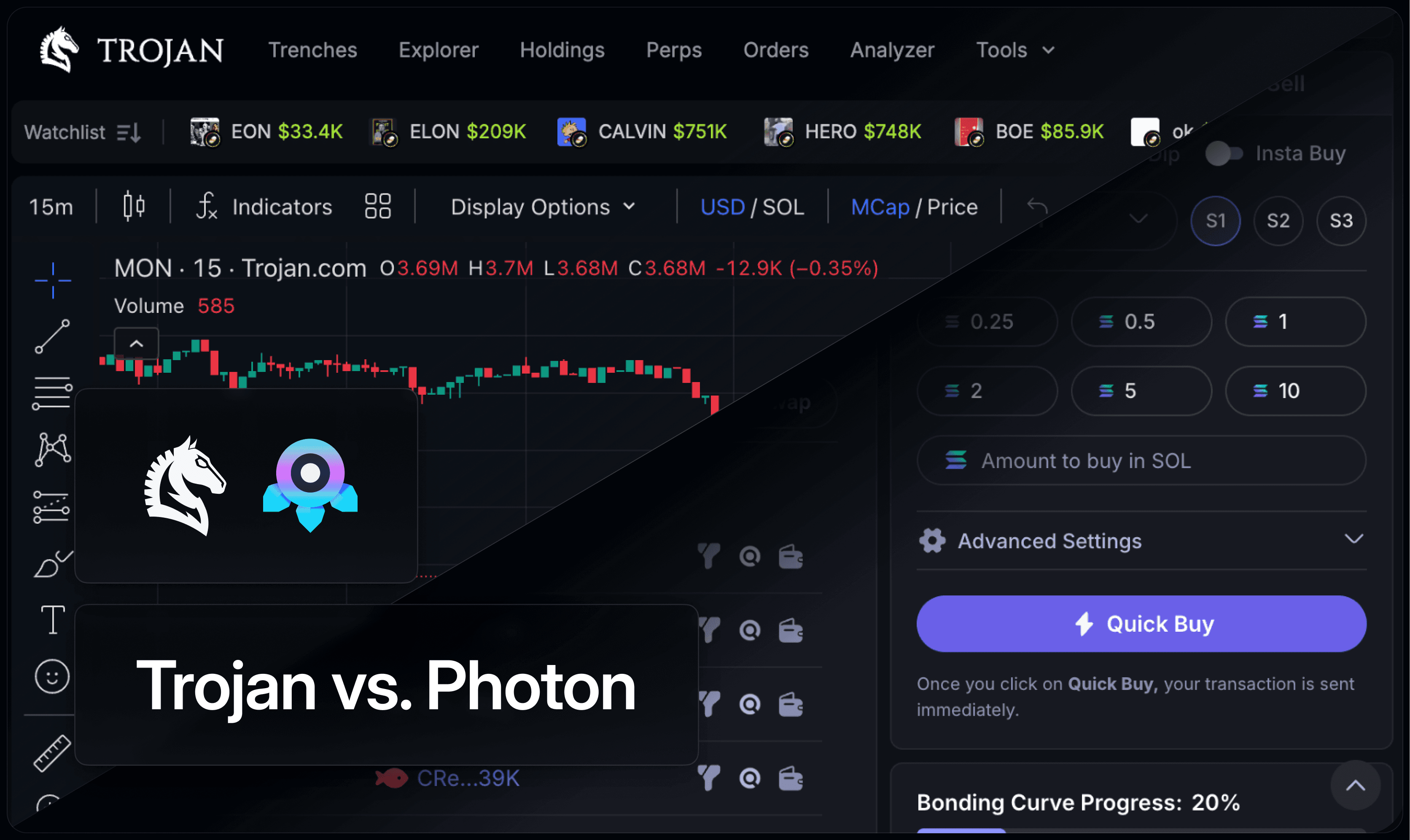
Trojan vs. Photon on Solana. A detailed, objective breakdown of fees, autosell automation, copy trading, rewards, UI design, and where each platform fits different trader profiles.

Silo
January 15, 2026
Synopsis
This article compares Photon and Trojan’s terminal on Solana, outlining Photon’s limited feature depth and incentive structure while examining how Trojan addresses those gaps with more complete automation, rewards, and trading infrastructure.
Intro
Onchain crypto trading moves at a thunderous pace and attempting to keep up is a fool’s errand without the tools. Combine that speed of action with unceasing change in technology and tool builders have to develop furiously or risk their user base moving to someone else. The driving force of trading tools now are web-based, non-custodial trading platforms.
For a time, crypto had a sea of competition, the tides of who would rule flowed back and forth constantly. The battle has now largely died and only a few platforms remain relevant to the discussion.
This will be the third in a short series of stacking the competition up against Trojan’s terminal. As always, we aim to be as honest and objective as possible by providing pros and cons, on both sides so that you can make the best decision for where to engage in your trading activity.
Today it’s Photon. Time to light the fires.
Who is the Competitor?
Originally coming into existence in early 2022, Tiny Astro (the creators of Photon) launched as an NFT data aggregating and monitoring platform. They launched a membership benefits NFT collection themselves during the same year, though the collection has since fallen into near flatline trading territory.
The following year, 2023, Tiny Astro launched Photon, their Solana web-based trading platform. While they subsequently expanded out into providing trading on other chains, we will be focusing strictly on Solana activity for this article.
Photon charges the standard industry rate of 1% per completed transaction. There are no cashback incentives.
What are Photon’s Pros?
Retaining users, especially in such a dynamic environment as crypto, requires one of three things generally: free stuff, features that are unique or superior to those found elsewhere, or user comfort/loyalty. So let’s take a look and see if we can find what retains their users.
First a quick note though, we’re not covering the basic stuff here, like do they have limit orders or wallet trackers. Unless they are lacking “standard equipment” or it is somehow poorly executed we don’t mention it. We expect that you expect it should be there.
Cruise Control
Photon has a feature they refer to as Autospeed. Essentially, when enabled, their system will automatically adjust the priority and bribe amounts based upon recently processed transactions. The idea being that you can have a better shot at successful fills, while not burning gas unnecessarily. This feature is largely outdated for all but the most novice of users today. The Solana network has matured, and when speed really matters the cost of gas usually doesn’t to traders.
Uncrowded UI/UX
One of the long-standing complaints with the vast majority of webapp trading terminals has been that they are poorly organized, crowded, and sometimes downright ugly. No trader wants to spend their days staring at a brutalized interface while attempting to battle it out in the trenches. Trading is hard enough. Photon’s colors and gradients are easy on the eyes and the layout is so open it verges on feeling vacant at times. It’s a matter of taste, but severely stripping down the data display can hurt quality, rapid decision making.
Time to End the Mayhem
With the introduction of Pumpfun’s Mayhem mode, sometimes traders are just looking to see when the chaos will end before entering. Photon provides both a large warning and a countdown timer until the close of mayhem on the coin’s chart interface. This can be beneficial, more data helps, but frankly, Mayhem doesn’t seem to have much life left. We see the value of the timer as minimal at best.
DCA For Once
This gets a mention because, while we consider DCA Orders to be a basic piece of the puzzle when it comes to trading, almost no one has it except us. Well, Photon has included the function. And while the inclusion is positive, the execution falls short of useful. The button to even create a DCA order is practically hidden, and while it provides the ability to create a marketcap range for the DCA, without direct on-chart displays it requires users to memorize and manually enter the range. It’s almost as though it’s designed to be difficult to use.
What are Photon’s Cons?
Just because a platform is able to offer the basics tolerably well, doesn’t mean that they don’t have gaps in development or areas where they completely drop the ball. Photon’s got their own faults. Let’s talk about some.
Referral System Without Rewards
This one is honestly kind of astonishing. Photon has a referral system. If you refer other users to come and trade on Photon you get…wait for it…points. What do these points do you ask? To date, nothing. There is no bonus, no fee sharing, nothing. Just the endless accrual of points to the user and fees to Photon.
Cashbackless
It’s become almost standard industry practice at this point to provide a Cashback incentive to users. Similar to a rakeback in poker, it’s the house returning a portion of the fees the user has paid back to them. This, indirectly, is also a way of decreasing the fee costs for trading on the platform. Without this all traders, regardless of volume and use, are paying 1% per transaction.
Autosell, But Not Really
Photon has a function called Autosell. However, unlike Trojan’s Autosell, they require that you create an order for every single token you buy and it has to be created inside the trade panel for that token. Additionally, there is only one Take-Profit and one Stop-Loss in their Autosell. Photon is essentially just creating a one-click dual limit order button. Not at all like Trojan’s Autosell automation.
No Copy-Trading
We’ve mentioned the idea of a set of basic tools. One of the most powerful ones in onchain trading that you can’t even get on CEXs is Copy-Trading. Being able to find a wallet that is skilled at getting alpha or being early to new metas or runners is a clutch method for making it big in the Trenches. You can’t watch another trader’s wallet all the time and you can’t click faster than the engine can react for you.
X-Tracker Missed the Mark
An X-Tracker on-platform is designed to serve two purposes: remove the requirement to endlessly refresh and search by providing a rolling curated feed and to eliminate user need to swap between platforms to take action on news/metas/alpha/etc. Photon provides the curated rolling feed, but keeps their X-Tracker on a completely separate tab from their trading area. This means a user needs to be on that tab already (instead of on a trading tab) and then they need to move to a trading tab and try to find the associated launch. Crypto moves too fast for those kinds of delays anymore.
We could detail many more issues here:
Photon only gives the ability to change your custom reflink once, ever
You can only get your private key once, meaning if you don’t capture it or accidentally misplaced it, you can never export the wallet (imagine if Photon ever went down permanently…)
The fact that their system flags bribe amounts of less that 0.012 SOL as too low. (It’s no wonder redditors complained at great length about their portfolio’s disappearing in fees and slippage with Photon.)
The incomplete integration of DEXs and Launchpads. New platforms are constantly being released, which means a constant need to update to stay current and there are several that are not supported..
Who is Trojan?
Trojan’s terminal is the next level of onchain trading brought to you by the same core team behind Trojan on Solana. We have taken everything we learned through the building and development of the most popular Telegram trading bot in crypto and funneled that knowledge into this new Onchain Exchange (OEX).
Trojan also charges a flat 1% fee on all completed trades, but there are cashback and rewards incentives that diminish that net cost for users considerably.
What are Trojan’s Pros?
As usual, we’re going to try and hit the high points in reverse order from the way they were presented for Photon, speak about where we fill in the gaps they leave behind and vice versa.
Top-Tier Gamified Rewards
One thing that can always be said about Trojan is that we believe in shared growth. Without our users, we don’t succeed and it’s why we work so hard to give back. Our entire model is to build tools that help you win. The Arena is the next evolution of Trojan’s rewards and referral program. Not only have we kept the 5-tier referral network we pioneered, but we provide generous cashback and referral percentages. Plus we turned the whole thing into a very cool game-like experience AND added a Jackpot that gives you a shot at winning 10% of the entire fee pool the Trojan platform makes every day. There’s really nothing like it.
A True Autosell Automation
As mentioned in previous blogs, to the active trader, there are few tools as useful as Autosell. With proper presets, Autosell allows a user to predetermine the risk profile they are willing to assume for their trades before they ever click the green button and, in truth, a trader could never have to manually click the “sell” button again. Autosell allows you to predetermine where your Stop-Loss and Take-Profit levels are for your trades and, when activated, will automatically place those levels the instant you click buy. Trojan allows for multiple levels for both SLs and TPs and you can easily make it global for all trades. No need for individual token activation.
X-Tracker Done Right
Trojan has built the X-Tracker the way it was meant to be. Able to me moved, docked next to the actual trading interface, or opened in a separate window. Our X-Tracker is right where you need it, when you need it, and provides exceptional filtering and customization options to keep Trojan users at the bleeding edge of the newest trends.
Simple DCA and Limit Orders
DCA and Limit Orders are at the heart of many trading strategies. We don’t want to hide them, or make them difficult to navigate. You’re already trying to make decisions quickly, the last thing you need is to have to hunt for how to enact a simple order. So we put them right where it’s most obvious. And we built the system so you can move your orders around at will on the chart or shift the DCA range for your buys/sells. Our UI/UX makes creating and editing orders an absolute breeze.
Miscellany
We have copy-trading. Photon doesn’t.
We have a watchlist. Photon doesn’t.
Trojan doesn’t gatekeep your private keys from you. We are non-custodial. Our users can export their wallets at will, they belong to you.
While we may suggest reasonable fees for trading, our routing is so streamlined outside of the most volatile situations gas and tip can be scaled way down and still result in accurate completed trades. Because of this variability Trojan provides easy access quick swap customizable gas/tip profiles per wallet, so users can scale their costs way down for stable non-volatile assets and up for fresh launches.
Photon only allows withdrawals to the signup wallet.
Photon doesn’t have a Consolidate function to allow funds to be drawn together from multiple wallets to one in a single transaction
And on.
What are our Cons?
No platform is without any room to improve. So let’s take a moment to reflect on where we might be missing something Photon provides.
Driving Manually
Trojan does not currently provide a system that will automatically adjust your gas and/or priority tip for you. We can understand how this might be a benefit for the most novice users learning to trade onchain, but there are two primary reasons we see this as unnecessary. Firstly, it takes only a very small amount of trial and error to gauge appropriate settings. Second, we’ve provided quick adjustment options for switching costs. But could this be a useful feature in some kind of simple mode for the novice, essentially abstracting away the need to expend thought on it? Maybe in a future update.
The Goldilocks of UI/UX Design
No one size fits all. It’s one of the reasons we build so much customization into Trojan Terminal. We want our users to operate in the environment that fits them best. We also know that with our users attempting to make high-value decisions in seconds or less, having instantly-digestible information immediately available can make the difference between massive wins and significant losses. To that end we scrutinized over every detail, every button, every icon, displaying the most necessary data where it was necessary and making less necessary, but useful data available with very little navigation. Some may say we have too much, others too little, but we think the vast majority will find it balanced just right.
PNL Calendar (updated)
Trojan provides pretty thorough and easily accessible information in our Wallet Analyzer interface. We give PnLs, trades, win/loss ratios, etc. etc. too much to really list out. But we don’t have a feature that allows you to have all that activity overlaid directly on a calendar display. UPDATE: We have a PnL Calendar now.
If it sounds like this is reaching, it’s because it is. There is genuinely very little, if anything, of significance that Photon has better than Trojan Terminal when it comes to trading on Solana.
Which is better?
Although at this point you’re probably thinking it’s a foregone conclusion, you might as well read the last few comments because you’re already here and you might be a little surprised.
Do we think that we are the best choice for traders on Solana? Yes, unquestionably. If we didn’t think we were the best choice we would be building differently. However, there may be one particular type of user that would find Photon useful. The absolute onchain trading novice as a stepping stone to moving on to Trojan.
With its simplified interface and gentle color palette, if a user were to ignore Photon’s warnings and scale their fees way way down, and if they only traded more established marketcap coins, and didn’t put too much in, then it might be a good place to get your feet wet before moving into a platform that is both rewarding and current with the requirements of the market.
But honestly, for all that, if you’ve ever used a CEX, you might as well move directly to Trojan, save some money on fees, have some fun, and learn a platform you can use for life.
Here’s a chart:
Trojan | Photon | |
|---|---|---|
Want Copy Trading | X | |
Want (real) Autosell | X | |
Want easy-to-use DCA | X | |
Want Autospeed | X | |
Want the Broadest Referral Circle | X | |
Want Comprehensive Documentation | X | |
Want a PNL Calendar | X | |
Want a Watchlist | X | |
Want a Referral Program that Rewards | X | |
Want Cashback | X |
Conclusion
This just really isn’t much of a neck-and-neck race. There is a lot that we never even got to covering here like perps or direct-USD1 trading integration among many many others.
Trojan Terminal is a premier onchain platform from one of the most respected and established teams in crypto. And while we are not done improving and building, we believe that Trojan offers an unmatched experience that is the best in the industry.
With Bitcoin roots stretching back to 2016 and “full‑time” status since 2021, Silo blends data‑driven writing with cryptonative expertise. As Trojan’s communications lead, he covers everything from trading tools to referral rewards, meme coins to market caps. In his spare time he writes sci-fi and lore.
More Posts
© 2025 Trojan Trading. All rights reserved.
Systems Operational