
Back
FDIC GENIUS Act Stablecoin Rules: What Circle and Coinbase Must Do Before 2027
The FDIC's April 7 NPRM implements GENIUS Act stablecoin rules covering reserves, yield prohibition, and custody requirements. Here is what Circle and Coinbase need to change before the January 2027 deadline.

Silo
April 9, 2026
Synopsis
The FDIC's April 7, 2026 NPRM imposes strict 1:1 reserve, no-yield, and custody requirements on permitted payment stablecoin issuers under the GENIUS Act. It also clarifies that reserve deposits are not pass-through insured. The new no-yield ban puts the lucrative Circle-Coinbase revenue-sharing partnership directly in the crosshairs.
The Federal Deposit Insurance Corporation moved swiftly on April 7, 2026, approving a sweeping Notice of Proposed Rulemaking that writes the final rules of the road for stablecoin issuers operating inside the U.S. banking system. The rule implements key provisions of the Guiding and Establishing National Innovation for U.S. Stablecoins Act, commonly called the GENIUS Act, which President Trump signed into law on July 18, 2025.
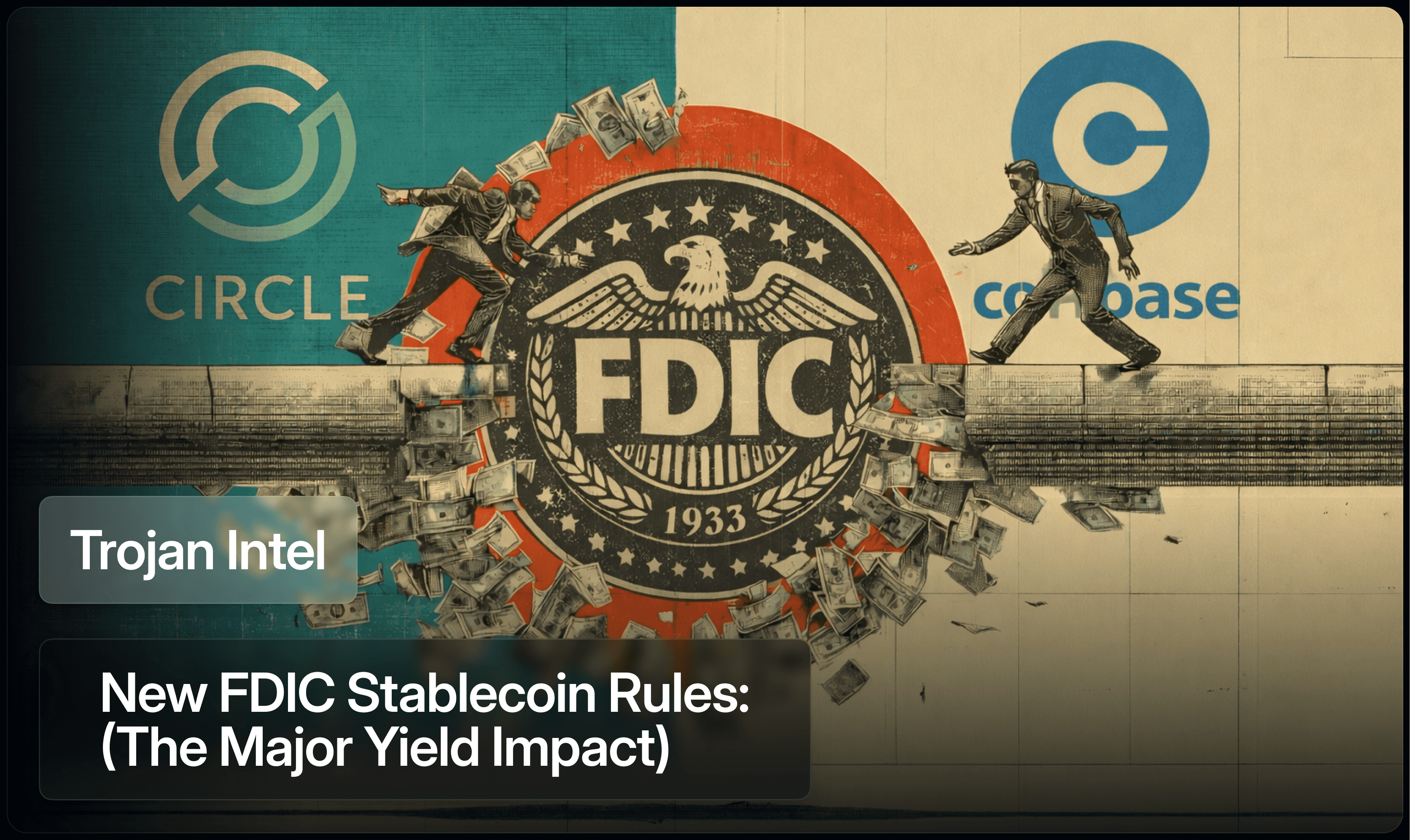
For most of the crypto industry, the NPRM reads as expected: prudent guardrails on reserves, strict segregation of assets, and a firm prohibition on issuers paying yield to stablecoin holders. But one provision, the no-interest rule and the way regulators are choosing to enforce it, threatens to blow up a revenue-sharing arrangement between Circle Internet Group (NYSE: CRCL) and Coinbase Global (NASDAQ: COIN) that has generated hundreds of millions of dollars and fueled USDC's rise to the world's largest regulated stablecoin.
$78B USDC MARKET CAP AS OF EARLY 2026 (CIRCLE) | $1.3B COINBASE STABLECOIN REVENUE REPORTED IN 2025 |
Jan. 18, 2027 GENIUS ACT EFFECTIVE DATE (OR 120 DAYS AFTER FINAL REGS) | 144 SPECIFIC QUESTIONS IN THE NPRM SEEKING PUBLIC COMMENT |
What the FDIC Actually Proposed
The NPRM, formally titled "GENIUS Act Requirements and Standards for FDIC-Supervised Permitted Payment Stablecoin Issuers and Insured Depository Institutions" (RIN 3064-AG19), is the FDIC's second rulemaking under the GENIUS Act. The first, issued in December 2025, handled application procedures for bank subsidiaries seeking to become Permitted Payment Stablecoin Issuers. This second rule builds on that foundation with the operational substance: what a licensed PPSI can and cannot do, and how it must be capitalized, audited, and supervised.
The rule targets a specific population: subsidiaries of FDIC-supervised insured depository institutions, primarily state nonmember banks and state savings associations. That population does not include Circle or Coinbase directly. But the reserve rules, the yield prohibition, and the deposit insurance clarifications affect both companies in ways that will force meaningful changes before the law takes effect.
The Five Core Requirements
The rule introduces five categories of requirements for licensed stablecoin issuers under FDIC jurisdiction.
REQUIREMENT | DETAIL | STATUS |
|---|---|---|
1:1 Reserve Backing | Every outstanding stablecoin must be matched by cash, Treasuries, or other high-quality liquid assets held in segregated, identifiable accounts. | REQUIRED |
No Interest or Yield | Issuers cannot pay holders any form of yield, whether directly or through affiliates, third-party intermediaries, or revenue-sharing arrangements. The FDIC adopts the OCC's rebuttable presumption standard. | PROHIBITED |
No Rehypothecation | Reserve assets cannot be pledged, lent, or reused. Narrow exceptions exist for liquidity management and repo agreements, most requiring FDIC approval or registered clearing. | PROHIBITED |
Redemption Standards | PPSIs must generally honor redemption requests within 2 business days. Concentration limits, including a 40% cap on certain asset classes, apply to reserve portfolios. | REQUIRED |
Public Disclosure | Monthly reserve disclosures are required for all issuers. Audited certifications are required for larger issuers. Weekly reports must be filed with the FDIC. | REQUIRED |
In addition to these operating requirements, the FDIC clarified two insurance questions that have hung over the stablecoin market. First, deposits held at banks as reserve assets backing a stablecoin will be insured at the corporate level, meaning the bank, not passed through to individual stablecoin holders. Second, tokenized deposits that meet the statutory definition of "deposit" under the Federal Deposit Insurance Act receive full normal insurance treatment.
KEY CLARIFICATION Stablecoin holders do not receive pass-through FDIC deposit insurance on the reserves backing their tokens. Coverage remains at the institutional level only. |
Circle and USDC: The Regulatory Path Is Already Set
Circle's situation is somewhat distinct from the FDIC rulemaking's primary scope. The company received conditional approval from the OCC in December 2025 to establish First National Digital Currency Bank, N.A., a proposed national trust bank that would bring USDC reserve management under federal OCC oversight rather than the FDIC's jurisdiction. That decision puts Circle squarely under the OCC's parallel GENIUS Act rulemaking, published February 25, 2026, rather than the FDIC's.
That regulatory path is a strategic win for Circle. The company has operated a full-reserve, publicly attested model for years, and management has been explicit that the GENIUS Act's standards align closely with how Circle already runs the business. USDC reserves are custodied at the Bank of New York Mellon and managed by BlackRock in a portfolio of short-dated Treasuries, overnight repo agreements, and cash. Monthly reserve attestations from a Big Four accounting firm are already public.
"The act aligned statutory requirements with Circle's standards, including high-quality liquid reserves, predictable redemption, and rigorous compliance." CIRCLE INTERNET GROUP, 2025 YEAR IN REVIEW |
The long-term competitive positioning looks favorable. With a $78 billion market cap for USDC and a nationally chartered trust bank in the works, Circle now holds a regulatory moat that offshore competitors like Tether currently lack. Institutional adoption of USDC has been accelerating precisely because of the legal clarity the GENIUS Act provides. Circle's partnership with Fidelity National Information Services to embed USDC into traditional banking infrastructure is one visible indicator of that momentum.
CIRCLE UPSIDE The GENIUS Act framework gives Circle a first-mover advantage in the institutional market. USDC's transparent, full-reserve model was essentially already compliant, and the OCC charter application positions it as the premier federally regulated stablecoin for banks, fintechs, and cross-border payments. |
The near-term pressure point is not the reserve rules. It is the yield prohibition, and specifically what regulators are saying about the revenue-sharing arrangement with Coinbase.
The Circle-Coinbase Revenue Deal: What Is Actually at Stake
The mechanics of the deal are straightforward. Under an agreement established in 2023, Coinbase receives 100 percent of the reserve income generated on USDC held within Coinbase's own platform. For USDC circulating outside Coinbase's platform, the two companies split reserve income on a roughly 50-50 basis. Coinbase in turn offers users approximately 4 percent annual yield through what it calls USDC Rewards, framing the program as a loyalty incentive rather than an interest payment.
The OCC, in its February 2026 rulemaking, established a rebuttable presumption that any arrangement in which an issuer pays yield to an affiliate or related third party, which then passes that yield to stablecoin holders, constitutes a prohibited interest payment under Section 4(a)(11) of the GENIUS Act. The FDIC's April 7 NPRM adopts the same standard. The combined regulatory weight of two of the three primary federal stablecoin regulators now treating this structure as presumptively illegal is significant.
REGULATORY RISK Both the OCC and FDIC have established a rebuttable presumption that Circle's revenue-sharing payments to Coinbase, which Coinbase uses to fund user-facing yield, violate the GENIUS Act's prohibition on issuer-paid yield. Companies can attempt to rebut the presumption, but regulators retain sole discretion on whether the rebuttal is sufficient. |
Legal analysts at Columbia Law School published a detailed analysis in December 2025 arguing the structure is likely already in violation of the Act. The analysis centers on a subtle but important point: under Coinbase's custodial wallet structure, Coinbase is legally the holder of USDC on its platform, not the end user. The end user holds only a beneficial interest. If Coinbase is the legal holder, Circle's payment to Coinbase satisfies the statutory definition of paying yield to the holder of the stablecoin, making it a direct violation rather than a third-party workaround.
Research published in ProMarket in March 2026 added empirical weight to that concern. The analysis found that Coinbase's USDC reward rates have tracked three-month Treasury yields at a 98.7 percent correlation across the full sample period, suggesting the rewards function economically as interest payments on reserve income regardless of how they are labeled.
The Deal Renewal and What It Means
The timing adds pressure. The Circle-Coinbase revenue-sharing agreement is up for renewal in 2026. Both companies face a choice: renew the deal in a form that may be challenged by regulators before it even takes effect under the January 2027 compliance deadline, or restructure the arrangement now to move toward an activity-based model that rewards USDC usage rather than passive holding.
Coinbase has been vocal in opposing broad yield restrictions. CEO Brian Armstrong wrote in February 2026 that a ban on stablecoin rewards would ironically make Coinbase more profitable in the short term, since the company pays out large amounts in rewards, but argued it would harm customers and U.S. competitiveness. The company's formal comment to Treasury framed rewards as loyalty programs that Congress deliberately carved out from the yield prohibition.
Wall Street sees it differently. Five major banking trade groups, including the American Bankers Association and Bank Policy Institute, have united behind a push for regulators to adopt a broad scope for the prohibition, arguing that any economic benefit tied to holding a stablecoin, including rewards paid through intermediaries, should be treated as prohibited yield. Their core argument is deposit flight: if stablecoins effectively offer 4 percent while bank savings accounts pay less, depositors will move money out of the banking system.
98.7% CORRELATION BETWEEN USDC REWARD RATES AND 3-MONTH T-BILL YIELDS (PROMARKET, 2026) | ~20% APPROXIMATE SHARE OF COINBASE TOTAL REVENUE FROM USDC-RELATED INCOME |
Timeline: From Rulemaking to Compliance Deadline
JULY 18, 2025 - GENIUS Act signed into law, establishing first comprehensive federal stablecoin framework and prohibiting issuers from paying interest or yield to holders.
DECEMBER 2025 - FDIC issues first GENIUS Act rulemaking covering bank subsidiary application procedures. OCC conditionally approves Circle's national trust bank charter application.
FEBRUARY 25, 2026 - OCC publishes 376-page GENIUS Act implementation rulemaking, introducing rebuttable presumption language targeting revenue-sharing arrangements like Circle-Coinbase.
APRIL 7, 2026 - FDIC Board approves this NPRM, aligning closely with OCC's approach and extending the rebuttable presumption standard to FDIC-supervised entities.
JULY 18, 2026 (TARGET) - Regulators aim to finalize rules, exactly one year after the GENIUS Act was signed. The FDIC NPRM comment period closes approximately 60 days after Federal Register publication.
JANUARY 18, 2027 (DEADLINE) - GENIUS Act takes effect, or 120 days after final rules are issued if earlier. All PPSIs must be in full compliance. Circle-Coinbase deal must be restructured or face legal challenge.
The Broader Picture: Banks Enter the Stablecoin Market
One dynamic that receives less attention in coverage focused on Circle and Coinbase is the GENIUS Act's role as an on-ramp for traditional banks. The FDIC rulemaking explicitly enables FDIC-supervised banks to issue stablecoins through subsidiaries. JPMorgan, Bank of America, and every FDIC-insured institution can now pursue that path. They arrive with existing regulatory relationships, established deposit infrastructure, and distribution networks that dwarf anything currently operating in crypto.
This competitive pressure is probably the stronger long-term threat to Circle's market position than any compliance cost from the reserve rules. If major banks begin issuing their own FDIC-supervised stablecoins by late 2026 or early 2027, USDC's current status as the de facto institutional-grade stablecoin is no longer guaranteed by default. Circle's answer to that threat is its OCC national trust charter, its Circle Payments Network, and its existing partnerships with BlackRock and Fidelity National Information Services.
Analysts at Citigroup project the stablecoin market, currently valued at approximately $320 billion, could reach $1.9 trillion by 2030. Even in a scenario where Circle gives up meaningful market share to bank-issued stablecoins, operating in a $1.9 trillion market at a reduced share could still represent dramatic growth from today's baseline. Circle's revenue grew 54 percent year-over-year in the most recent quarter, with USDC circulation generating $672 million in revenue and $131 million in adjusted EBITDA.
What Coinbase Does Next
Coinbase's situation is more operationally immediate. The company is not a stablecoin issuer and faces no new licensing requirements under the FDIC rule. But the revenue consequences of the yield prohibition, if enforced as written, are material. Stablecoin revenue represents approximately 20 percent of Coinbase's total revenue, and a large portion of that flows from the Circle revenue-sharing structure.
The most likely path forward is restructuring USDC Rewards from a passive-holding program into an activity-based loyalty model. Rewards tied to transactions, payments, or other uses of USDC rather than simply to the balance sitting in a Coinbase wallet present a stronger legal argument for permissibility under the statute's text. That approach mirrors how credit card rewards programs are structured, and it is the direction multiple crypto policy analysts expect the industry to move regardless of how the final rules read.
Some analysts note an irony in the near-term financials. If Coinbase eliminates the rewards program, the company stops paying out the substantial amounts it currently distributes to users, potentially improving margins in the short run even as it loses the incentive that attracts and retains USDC balances on platform. Coinbase's Armstrong acknowledged this math explicitly in his February comments on the proposed restrictions.
ANALYST VIEW Multiple analysts, including Bitwise Research and Clear Street, have described the Circle stock selloff in late March as an overreaction. Circle remains up more than 30 percent year-to-date following that correction, and the long-term USDC adoption curve remains intact regardless of how the yield question resolves. |
What to Watch During the Comment Period
The FDIC is seeking comment on 144 specific questions, with submissions due approximately 60 days after Federal Register publication. Several areas are particularly worth tracking for anyone following the Circle-Coinbase story or the broader stablecoin market.
The rebuttable presumption standard is the most consequential open question. Whether the FDIC narrows or expands the language used in the final rule will determine whether the existing Circle-Coinbase structure is clearly prohibited, clearly permitted, or left in an ambiguous zone that invites litigation. Regulators have invited comments on how to distinguish issuer payments from genuine third-party loyalty programs, which suggests they are not settled on the precise boundary.
The 40 percent concentration limit on certain reserve assets has drawn scrutiny from some observers as potentially too permissive, depending on which assets qualify under the definition. The treatment of smaller issuers, those with under $10 billion in outstanding stablecoins who may qualify for state-level regulation rather than federal oversight, is another area where the final rule could diverge from the proposal in ways that affect competitive dynamics.
Finally, the alignment question between the FDIC, OCC, Federal Reserve, and NCUA is explicitly raised in the NPRM. The FDIC notes it has endeavored to align this proposal with the OCC's rule, but invites comment on whether further harmonization is needed. Inconsistent treatment across regulators would create arbitrage opportunities and compliance confusion for issuers that operate across multiple regulatory perimeters.
Bottom Line
The FDIC's April 7 NPRM is a serious and carefully constructed piece of regulatory architecture. It does not contain the kind of ambiguities or carve-outs that would allow the stablecoin industry to avoid the core discipline of the GENIUS Act. The 1:1 reserve requirement is strict, the yield prohibition is targeted with precision at the Circle-Coinbase structure, and the deposit insurance clarifications remove a source of consumer confusion that had persisted since the law was signed.
For Circle, the net effect is positive over any reasonable time horizon. The company positioned itself early for exactly this regulatory environment, and the OCC charter path gives it the institutional credibility to win the stablecoin business of the traditional banks now entering the market as competitors. The revenue-sharing deal with Coinbase will need restructuring, but Circle's core reserve management and compliance infrastructure are already aligned with what the law requires.
For Coinbase, the pressure is more acute in the near term. The USDC Rewards program as currently designed sits in regulators' crosshairs, the revenue-sharing deal is up for renewal in 2026, and the company will need to negotiate a new arrangement with Circle before the January 2027 compliance deadline. An activity-based loyalty model likely survives the regulatory scrutiny. A passive-yield program that tracks Treasury rates at 98.7 percent correlation almost certainly does not.
The comment period closes roughly 60 days after Federal Register publication, and final rules are expected by July 2026. The window for both companies to shape the outcome through public comment and negotiation with regulators is open, but narrowing quickly.
DISCLOSURE AND NOTES
This article is based on the FDIC's April 7, 2026 Notice of Proposed Rulemaking (RIN 3064-AG19), the OCC's February 25, 2026 GENIUS Act rulemaking, publicly available financial filings from Circle Internet Group and Coinbase Global, and independent analysis from Columbia Law School's CLS Blue Sky Blog, ProMarket, Ledger Insights, and CoinDesk. This article does not constitute legal or investment advice. All rules discussed remain in proposed form and are subject to change following the public comment period.
With Bitcoin roots stretching back to 2016 and “full‑time” status since 2021, Silo blends data‑driven writing with cryptonative expertise. As Trojan’s communications lead, he covers everything from trading tools to referral rewards, meme coins to market caps. In his spare time he writes sci-fi and lore.
More Posts



© 2025 Trojan Trading. All rights reserved.
Systems Operational