
Back
Arena Dispatch #010: CLARITY Act at 92%, Solana TPS ATH, and Hong Kong Stablecoin Licenses
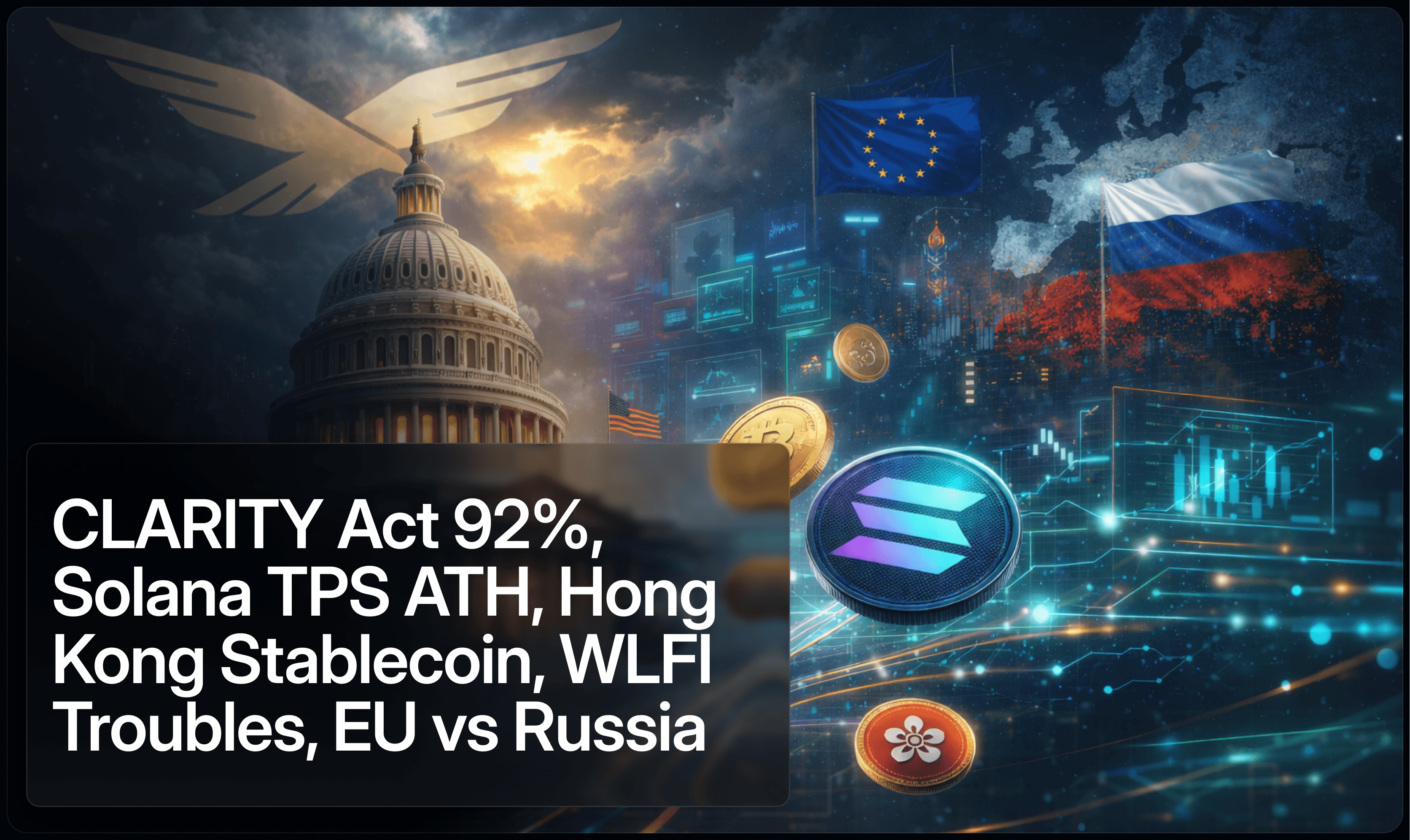
Crypto news brief that centers on CLARITY Act momentum, Solana Firedancer rollout, Hong Kong stablecoin licenses, and EU Russian crypto bans.

Silo
February 23, 2026
Synopsis
U.S. lawmakers pushed CLARITY Act odds toward passage as the SEC dropped major exchange cases and clarified meme coin status, while Solana hit new throughput highs and expanded RWA integrations. Hong Kong advanced stablecoin licensing as the EU tightened Russian linked crypto bans.
US regulatory momentum accelerates
CLARITY Act odds climb
Senator Bernie Moreno publicly placed CLARITY Act passage odds near 92% by April, reinforcing growing bipartisan support. White House stablecoin talks continued to refine capped yield allowances for non-bank issuers, building on earlier compromise frameworks.
The direction favors structured innovation rather than prohibition, with stablecoin policy and market structure moving in tandem.
SEC enforcement shift and Project Crypto
SEC Chair Paul Atkins dropped enforcement cases against Binance and Coinbase and issued clarifying guidance stating that memecoins, staking, and many stablecoins do not constitute securities under current interpretations.
Project Crypto, the SEC and CFTC coordination track, continues to position the U.S. as a primary digital asset jurisdiction. Reduced enforcement overhang immediately fueled renewed risk appetite in high-beta sectors.
GENIUS Act and stablecoin oversight
Treasury reiterated that the strategic reserve consists solely of seized BTC. The FDIC framework for bank-issued stablecoins continues to emphasize 1-to-1 backing, rapid redemption, and capital buffers.
Stablecoin oversight is shifting from ambiguity to operational supervision, with Q2 2026 targeted for clearer implementation.
Market context
Total crypto market capitalization hovered near 2.2 trillion dollars, down modestly across the window. Bitcoin traded near 65,000 dollars while Solana fluctuated around 80 dollars. A 2.8 billion dollar options expiry added short term pressure.
Volatility remains event driven, but policy clarity is offsetting deeper structural risk repricing.
Solana ecosystem expansion and throughput highs
Solana TPS ATH and Firedancer rollout
Solana recorded new throughput highs in 2026 as Firedancer validator adoption expanded. Sub-second finality and diversified client infrastructure continue to reduce single-point failure risk.
Alpenglow consensus preparation remains on track for 2026, targeting further reductions in finality time and reinforcing Solana’s positioning as a high-frequency settlement layer.
RWA and AI integration momentum
Solana’s RWA total value locked exceeded 1.65 billion dollars. Phantom introduced AI MCP integrations, Zora advanced Attention Markets, and xplace launched a dApp store model.
New launches such as DFlow AI trading, InfraMarkets prediction rails, and Realms DAO group investing signal a shift from pure memecoin cycles toward AI and real world asset infrastructure.
USD1 volatility and WLFI account compromises
World Liberty Financial faced renewed scrutiny after multiple associated X accounts were compromised, most recently on February 23, 2026. Attackers gained access to several co-founder accounts and used them to spread negative narratives around USD1 while allegedly taking short positions to profit from induced volatility.
Importantly, WLFI stated that no smart contracts, reserves, or protocol infrastructure were breached. The incident was limited to social media account access. USD1 briefly traded below peg, dipping as low as 0.98 on some venues, before recovering to parity.
International divergence intensifies
Hong Kong stablecoin licenses
Hong Kong’s HKMA confirmed plans to issue its first batch of stablecoin issuer licenses in March 2026 under a strict regime enacted through the 2025 Stablecoins Ordinance.
Thirty-six applicants are under review, with requirements centered on AML controls, asset backing, and credible operating models. Despite Beijing’s broader crypto stance, Hong Kong’s framework may channel regional flows into compliant stablecoin ecosystems, potentially benefiting chains integrated with regulated issuers.
EU Russian linked crypto bans
The European Commission advanced proposals to prohibit EU entities from engaging with Russian linked crypto providers and successor platforms to previously sanctioned exchanges. Additional banks were added to sanctions lists, and digital ruble activity faced explicit prohibition.
The tightening regime targets evasion via stablecoins and unsanctioned platforms. Analysts note that restrictive EU policy could redirect certain flows toward decentralized chains outside EU jurisdictional reach.
Perspective
February 20 to 23 reinforced a bifurcated environment. U.S. regulation is consolidating around pro-innovation stablecoin and market structure frameworks, while Hong Kong advances controlled openness and the EU tightens sanctions enforcement.
In high-velocity conditions, execution and wallet-level visibility matter. On Solana, tooling layers such as Trojan provide monitoring and trading infrastructure aligned with rapid issuance cycles and regulatory driven narrative shifts.
With Bitcoin roots stretching back to 2016 and “full‑time” status since 2021, Silo blends data‑driven writing with cryptonative expertise. As Trojan’s communications lead, he covers everything from trading tools to referral rewards, meme coins to market caps. In his spare time he writes sci-fi and lore.
More Posts


© 2025 Trojan Trading. All rights reserved.
Systems Operational